
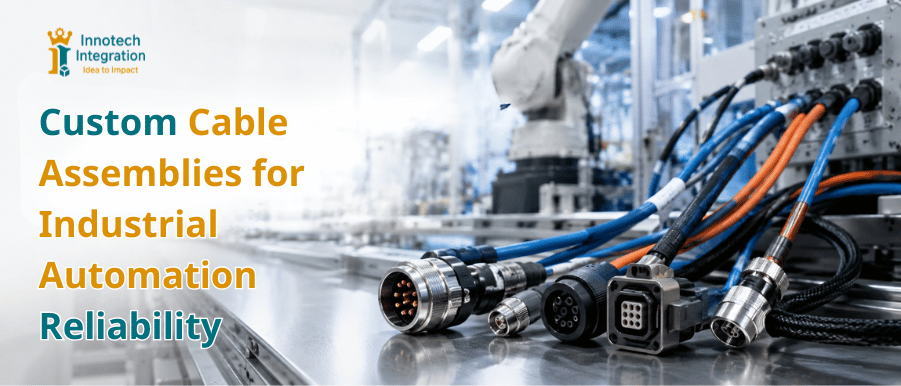
Reliability Starts Long Before the Machine Turns On
In a highly automated factory, one small failure can create an oversized problem. A robotic arm stops mid-cycle. A sensor drops signal. A medical device subassembly fails validation. A control cabinet begins showing intermittent faults that no one can reproduce consistently. The cable may look like the simplest part of the system, but when it fails, the entire operation can stop.
For US manufacturers, industrial automation teams, medical technology companies, and industrial IoT OEMs, downtime is not just inconvenient. It can cost thousands of dollars per minute, and in some environments, unexpected downtime can reach up to $150,000 per hour (Info2Soft Unplanned Downtime Cost 2026). Cable-related failures are often a hidden contributor, especially in systems exposed to motion, vibration, heat, chemicals, moisture, and electromagnetic interference.
That is why custom cables and cable assemblies are not just “wires with connectors.” They are engineered reliability components.
Why Off-the-Shelf Cables Often Fall Short
Off-the-shelf cables work well when the application is simple, static, and predictable. Industrial automation is rarely simple. Machines are compact. Components move. Control panels get crowded. Connectors must fit tight spaces. Cable runs pass near motors, drives, sensors, power supplies, and high-frequency switching equipment.
A generic cable may be the right length but the wrong flexibility. It may have the right connector but poor shielding. It may fit during installation but fail after repeated bending. It may survive clean environments but degrade quickly when exposed to oil, coolant, solvents, heat, or washdown cleaning.
The danger is that standard cables often look acceptable during early testing. The failure appears later, after thousands of motion cycles or months of exposure to the real operating environment.
Custom cable assemblies are built around the actual application, not a catalog assumption.
The Most Common Failure Point Is the Connector Junction
In many industrial cable failures, the problem begins where the cable meets the connector. This junction takes the most mechanical stress. It sees pulling, bending, twisting, vibration, and accidental handling during maintenance.
A custom assembly can be designed with the right strain relief, overmolding, bend-radius protection, and connector orientation for the exact motion profile of the machine. For robotic arms, gantries, drag chains, test equipment, and mobile industrial platforms, this matters enormously.
When strain relief is poorly designed, the conductor can fatigue internally even if the outside jacket looks fine. The result is intermittent failure, which is often the worst kind of failure because it is difficult to diagnose and easy to misattribute to software, sensors, or controls.
A properly engineered cable assembly reduces that risk at the design level.
Design for Manufacturing Prevents Problems Before Production
One of the best ways to improve reliability is to involve a manufacturing partner early in the design phase. This is where Design for Manufacturing, or DFM, becomes critical.
Engineers may define the electrical requirements correctly but miss manufacturability details that affect long-term performance. Bend radius may be too tight for the selected cable. Connector tolerances may not match the enclosure or mating component. Shield termination may be incomplete. The cable jacket may not tolerate the temperature or chemical exposure. Labels may be missing or placed where they become unreadable after installation.
These issues are easier and cheaper to fix before tooling, sourcing, and production begin.
An experienced manufacturing partner can review the design for routing, connector fit, crimp quality, assembly sequence, shielding strategy, strain relief, testing requirements, and serviceability. This prevents field adaptations, splicing, extra adapters, and last-minute changes that create new failure points.
EMI Protection Is Essential in Automation Environments
Industrial automation environments are full of electrical noise. Variable frequency drives, motors, relays, welding equipment, high-speed switching circuits, and power electronics can all create electromagnetic interference. If a cable assembly is not properly shielded, that noise can corrupt sensor readings, interrupt communication, distort signals, or cause intermittent machine faults.
Custom cable assemblies allow engineers to choose the right shielding approach for the application. This may include braided shielding, foil shielding, drain wires, twisted pairs, shielded connectors, and proper 360-degree shield termination. The goal is to protect signal integrity and reduce noise without adding unnecessary bulk or cost.
This is especially important in industrial IoT systems, machine vision, robotics, medical equipment, and control systems where clean data transmission is as important as power delivery.
A cable is not just carrying current. In many systems, it is carrying decisions.
Material Selection Should Match the Real Environment
Cable jacket material has a direct impact on lifespan. Standard PVC may be acceptable for basic indoor use, but it can fail in harsher industrial conditions. Heat, oil, UV exposure, abrasion, cutting fluids, cleaning chemicals, and repeated flexing can all break down the wrong material.
Custom assemblies allow the jacket and insulation materials to be chosen for the actual operating environment. Silicone can support high-temperature flexibility. Polyurethane, or PUR, offers strong abrasion and oil resistance. TPE can provide flexibility, chemical resistance, and durability across demanding use cases.
In extreme applications, materials may need to tolerate temperatures up to 250°C, resist industrial solvents, or survive constant movement in drag chains. This kind of performance cannot be assumed from a generic cable.
The right material choice helps prevent cracking, swelling, stiffening, signal loss, and premature replacement.
Compact Routing Matters in Complex Box-Builds
Modern electromechanical systems are becoming more compact. Control boxes, medical devices, automation modules, robotics controllers, and industrial IoT enclosures often have very little room for excess cable length or bulky connector layouts.
Poor cable routing creates more than a messy build. It can block airflow, interfere with service access, increase bend stress, rub against sharp edges, or make assembly inconsistent from unit to unit.
Custom cable assemblies solve this by matching the exact length, connector angle, branch points, labeling, and routing path needed inside the system. In complex box-builds, that precision improves assembly speed and reduces human error.
Color-coding and clear labeling also help during installation, testing, and maintenance. When technicians can quickly identify each connection, they are less likely to miswire, force the wrong connector, or waste time troubleshooting avoidable mistakes.
IP68 Waterproof Compliance for Harsh Environments
Industrial equipment is not always protected inside clean, climate-controlled spaces. Some systems operate in washdown areas, outdoor enclosures, agricultural equipment, transportation systems, marine environments, food processing facilities, and dusty manufacturing zones.
For these applications, waterproof and dust-resistant designs become essential. IP68-rated cable assemblies can support protection against dust ingress and prolonged water exposure when designed and validated correctly.
This requires more than choosing a sealed connector. The complete assembly must be considered: connector seals, cable jacket compatibility, overmolding, strain relief, mating interface, and assembly process. A weak point anywhere in the chain can allow moisture intrusion.
For harsh environments, sealing performance is a reliability requirement, not an optional upgrade.
Sensor Integration Can Reduce Complexity
In advanced automation systems, cable assemblies may do more than connect components. They can integrate sensors directly into terminations or harness branches, reducing assembly complexity and improving packaging.
This approach can support condition monitoring, position feedback, temperature sensing, load detection, or other application-specific needs. Integrating sensors into the cable assembly can reduce separate mounting steps, simplify routing, and improve repeatability in production.
The benefit is not only a cleaner assembly. It is a more controlled, testable, and scalable design.
When cable assemblies become part of the intelligence layer of the system, manufacturing quality and functional testing become even more important.
Custom Assemblies Remove Field Adaptation Risk
Field adaptations are a common source of reliability problems. When a cable is too short, too long, incorrectly terminated, or incompatible with the enclosure, technicians may compensate with extensions, adapters, splices, cable ties, or improvised routing.
Each workaround adds a potential failure point.
Custom assemblies eliminate these compromises by matching the system requirements from the start. The cable arrives at the correct length, with the correct connector, correct orientation, correct shielding, correct labeling, and correct test documentation.
This is especially valuable for OEMs building repeatable systems. If every unit is assembled the same way, quality improves and troubleshooting becomes easier.
Strategic Sourcing Is Now a Reliability Factor
For US OEMs, supply chain volatility remains a serious pain point. Component availability, connector lead times, material shortages, price swings, and quality variation can all disrupt production. A cable assembly is only as reliable as the components and processes behind it.
This is where strategic sourcing becomes part of engineering reliability.
Innotech Integrations supports customers with global sourcing capabilities and SAP-integrated Supply Chain Management. This helps balance competitive pricing with controlled quality, traceability, and procurement visibility. Instead of treating sourcing as a separate purchasing task, Innotech connects sourcing, manufacturing, inventory, quality, and delivery through a more disciplined contract manufacturing ecosystem.
That matters for OEMs that need flexibility without losing control. Competitive pricing is important, but not at the cost of inconsistent components, poor documentation, or unreliable supply.
Testing Turns Good Builds Into Trusted Assemblies
A cable assembly can look perfect and still fail electrically. That is why testing must be built into the process.
For industrial and electromechanical applications, functional testing confirms that the assembly performs as intended in the larger system context. Continuity checks verify connections, but they are only the beginning. Dielectric high-voltage testing helps identify insulation weaknesses and verifies that the assembly can withstand required electrical stress.
Depending on the application, testing may also include insulation resistance, pull testing, connector fit verification, signal checks, polarity validation, and visual inspection against workmanship standards.
Innotech’s testing capabilities help customers catch defects before assemblies move into final integration or field deployment. This reduces rework, warranty risk, and downtime after installation.
Innotech’s Contract Manufacturing Ecosystem
Innotech Integrations does more than build cable assemblies. The company supports a broader contract manufacturing ecosystem where cable assemblies, wire harnesses, box-builds, electromechanical integration, sourcing, testing, and quality control work together.
That is a major advantage for customers developing industrial automation equipment, medical devices, IoT systems, control panels, and complex electromechanical products. The cable assembly is not treated as a disconnected commodity. It is engineered and integrated as part of the complete system.
This helps prevent common gaps between design intent and production reality. A cable that works on the bench must also route cleanly inside the enclosure, pass testing, connect reliably to mating hardware, survive the environment, and be repeatable in manufacturing.
Innotech’s value is in helping customers make that full transition with fewer failures and fewer surprises.
Why Reliability Is Built, Not Assumed
Reliable industrial automation depends on thousands of small decisions. Cable length. Connector type. Crimp quality. Shield termination. Jacket material. Label placement. Bend radius. Overmolding. Strain relief. Test procedure. Sourcing discipline.
Any one of these details can become a weak point if ignored.
Custom cable assemblies give engineering teams control over those details. They help prevent premature failure, reduce downtime, improve serviceability, and support consistent production quality. For US OEMs dealing with high reliability expectations and supply chain pressure, that control is a competitive advantage.
In industrial automation, medical systems, and industrial IoT, cable assemblies are not minor accessories. They are mission-critical reliability components. Off-the-shelf cables may be convenient, but they often fail to meet the spatial, mechanical, environmental, and electrical demands of real-world equipment.
Custom cable assemblies improve reliability through better strain relief, application-specific materials, EMI shielding, IP68 sealing, sensor integration, compact routing, precise labeling, and validated testing. When combined with early DFM support, global sourcing, SAP-integrated SCM, and full electromechanical integration, they become part of a stronger manufacturing strategy.
Innotech Integrations helps customers move beyond the wire by delivering cable assemblies that are engineered, sourced, tested, and integrated for real industrial performance.

